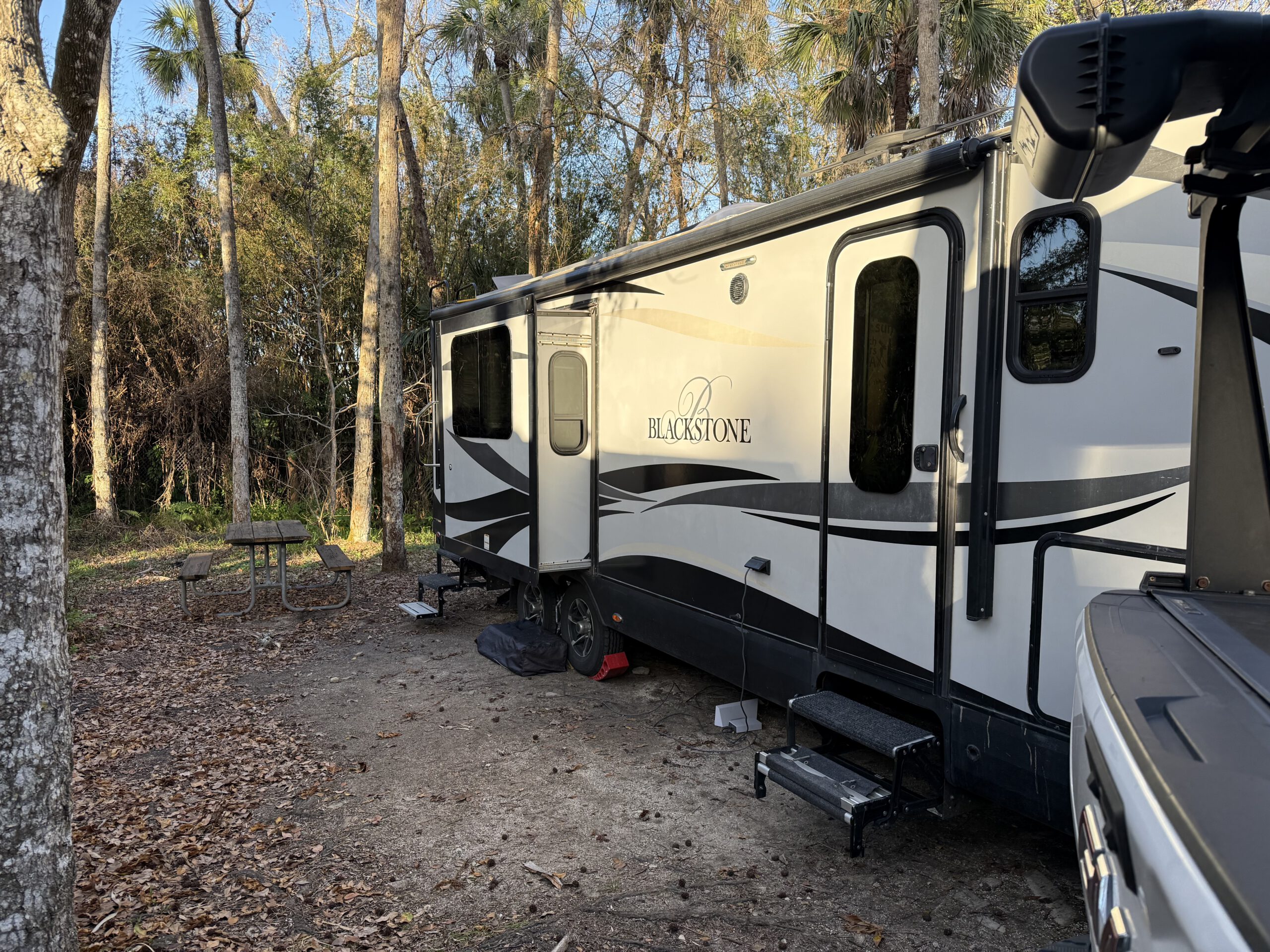
On February 18, 2026, we booked one of the last three remaining sites at Manatee Hammock Campground, just across the water from Kennedy Space Center. The reservation system showed very limited availability, so we selected a site larger than our trailer required simply because it was available. Upon arrival, however, we were told the site was “too large” for our trailer and were reassigned to a smaller space — without any adjustment in price. A quick scan of social media reviews later confirmed that this seems to be a common experience.
The park itself is well positioned. The real draw here isn’t luxury — it’s proximity. You are directly across the Indian River from Kennedy Space Center, and when rockets launch, this is one of the more accessible public vantage points. That geography alone makes it worth considering.
We pushed a little harder on our travel day because we hoped to witness a Falcon 9 launch from the shoreline that evening. After getting settled, we learned the launch had been postponed by 24 hours. Spaceflight, it turns out, operates on its own timetable.
On February 19th, we spent the entire day at Kennedy Space Center. It is not a quick stop. It is a full immersion. For me, this visit carried some weight. I was a young man during the Apollo years — 1969 through 1972 — watching grainy television broadcasts as humans first stepped onto another world. To stand decades later beneath the hardware that made that possible is something altogether different.
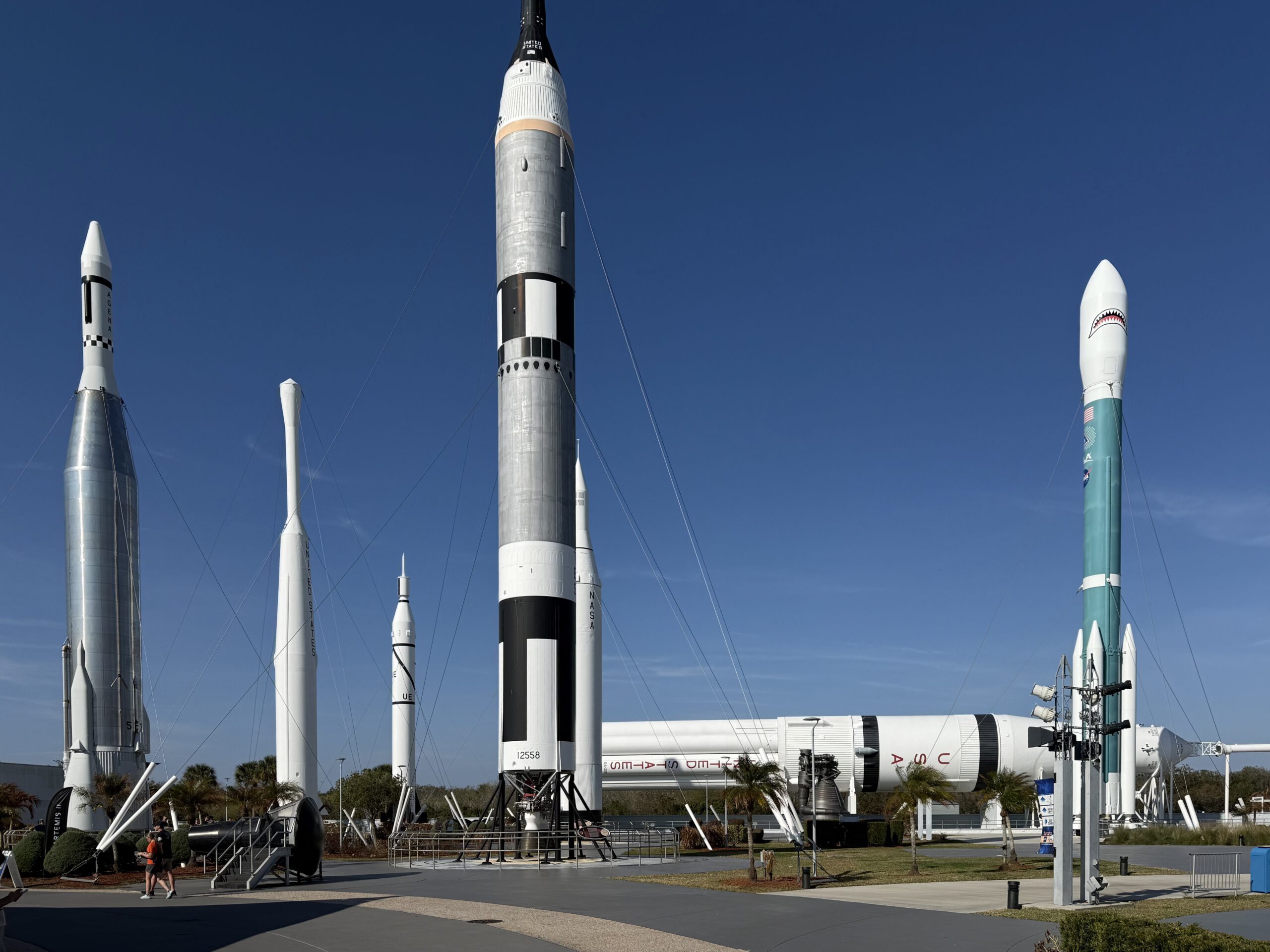
The Rocket Garden is where America’s early ambitions stand upright. Mercury-Redstone, Mercury-Atlas, Gemini-Titan — the machines that pushed the boundary step by step. They are smaller than modern rockets, but in many ways more astonishing. These were the vehicles that first carried Americans into space when success was uncertain and failure was very visible. Walking among them feels less like viewing artifacts and more like standing in the early chapters of a very bold experiment.
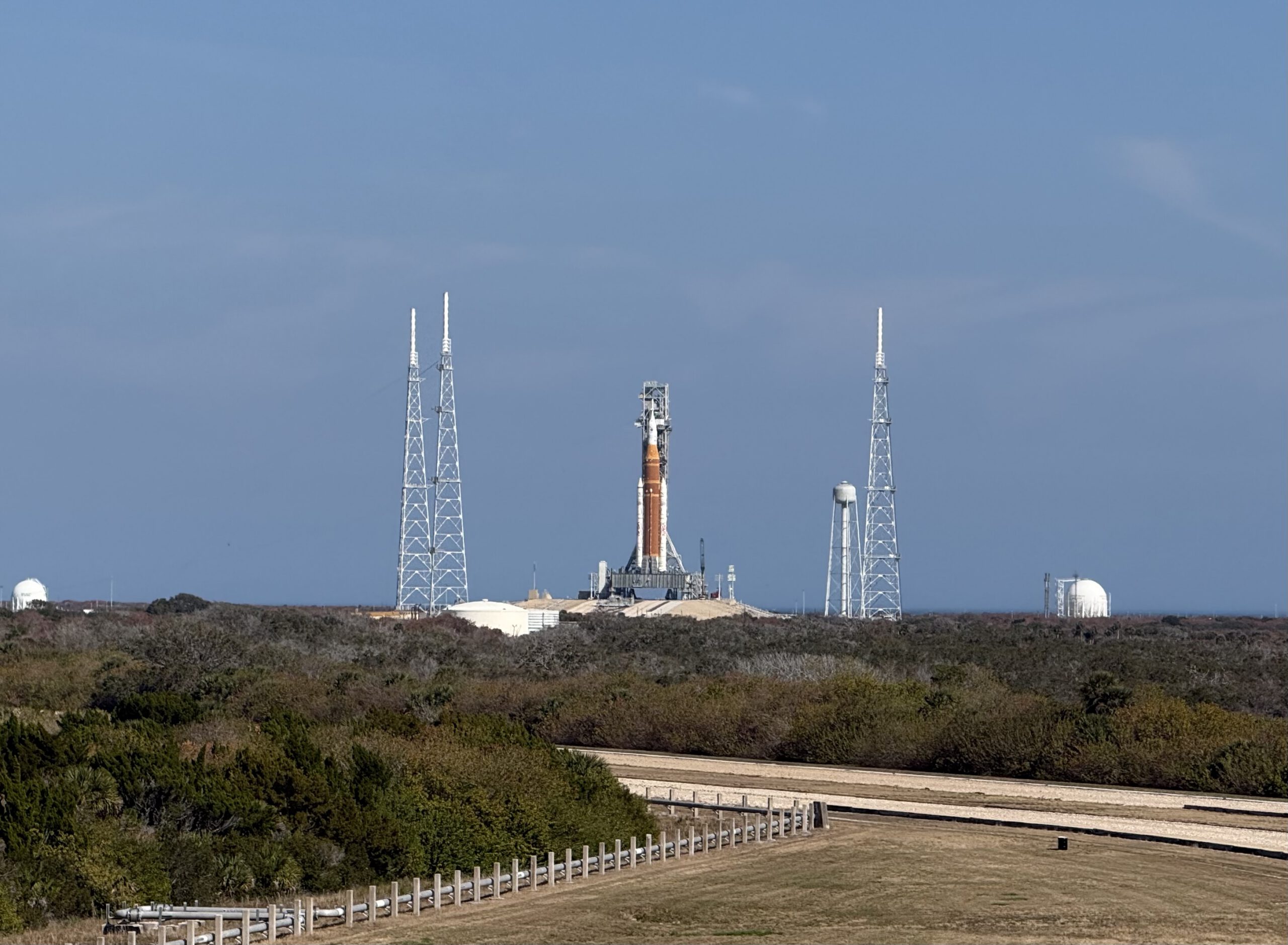
We were able to see the Artemis Space Launch System (SLS) standing on the pad awaiting its upcoming March launch window. It is massive — the most powerful rocket NASA has ever built. The scale is hard to communicate until you see it in person. This is not nostalgia; it is continuation. The hardware on the pad represents a return to deep space ambitions, with the stated goal of sending humans back to the Moon — and eventually onward to Mars.
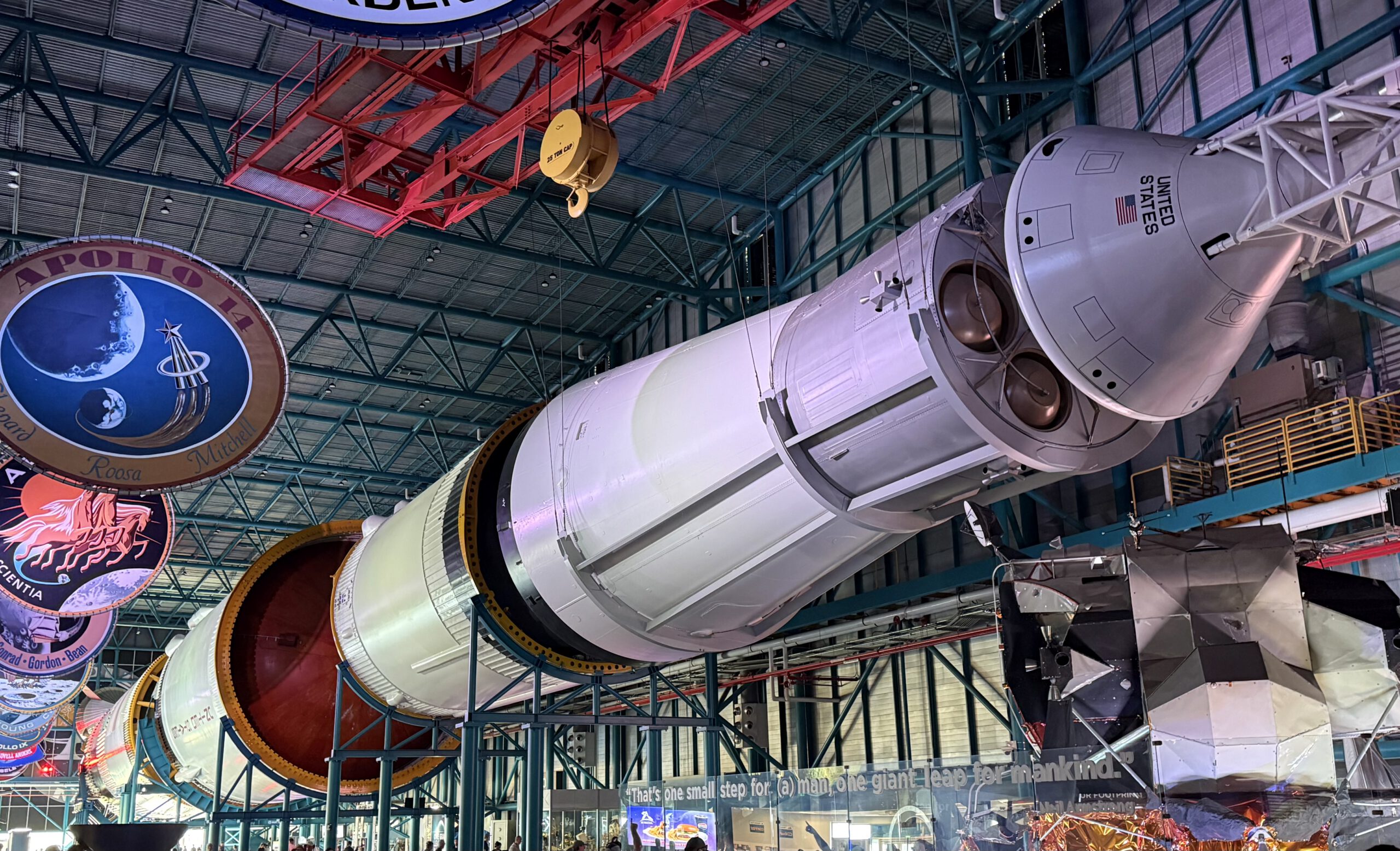
The Saturn V is displayed horizontally inside the Apollo/Saturn V Center. It stretches nearly the length of a football field. Standing beneath the five F-1 engines in the first stage, you begin to grasp the scale of what it took to leave Earth. The command module, suspended nearby, appears almost fragile by comparison. That tiny capsule carried three men to lunar orbit and brought them home at 25,000 miles per hour. The engineering margin was thin. The courage margin was thinner.
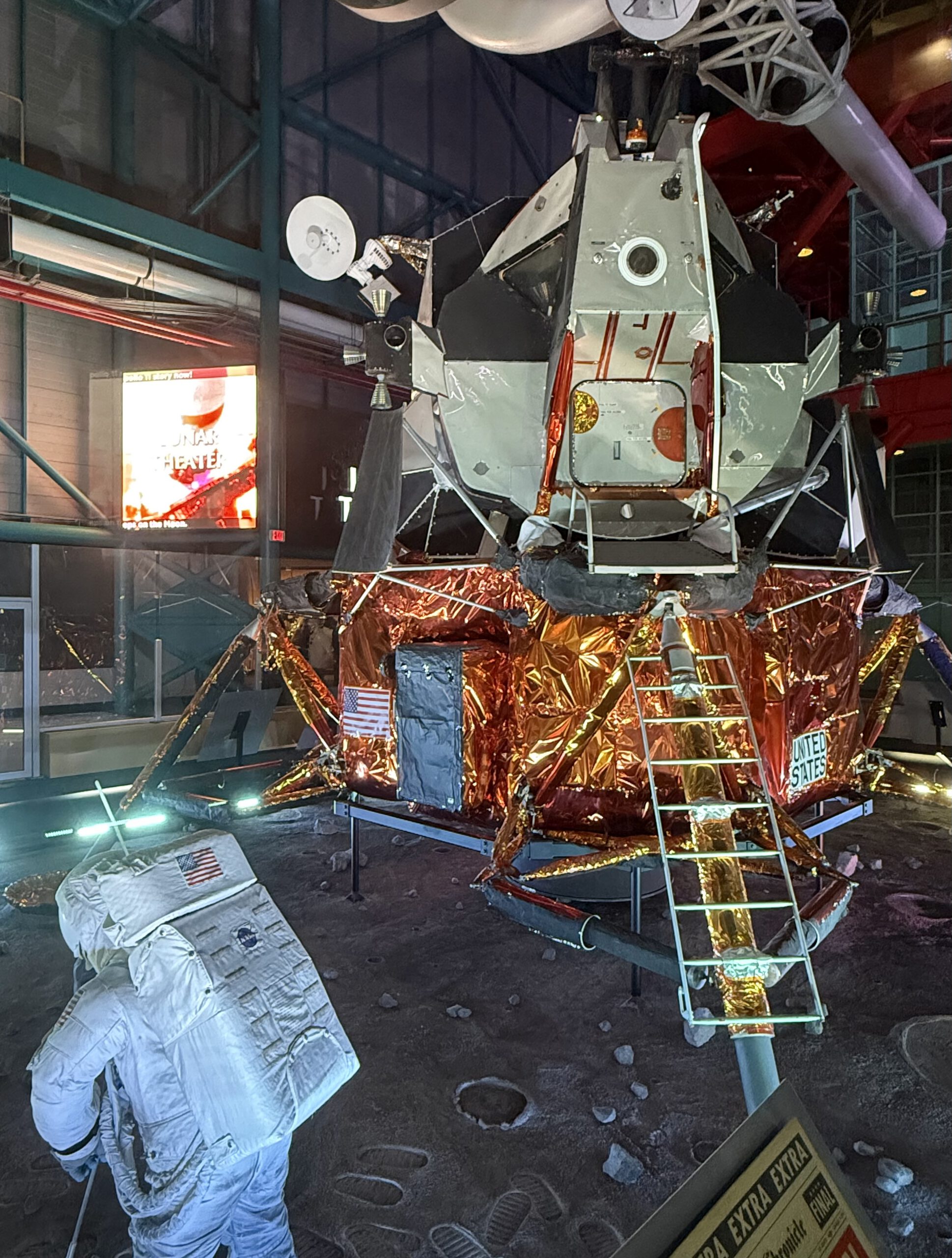
The Lunar Module looks improbable — angular, spindly, wrapped in gold foil. It was never designed to fly in Earth’s atmosphere. It existed solely for the vacuum of space and the surface of the Moon. Seeing it up close reinforces how specialized the mission was. This was a machine built for one purpose: land, explore briefly, and leave. Nothing about it suggests comfort. Everything about it suggests precision.
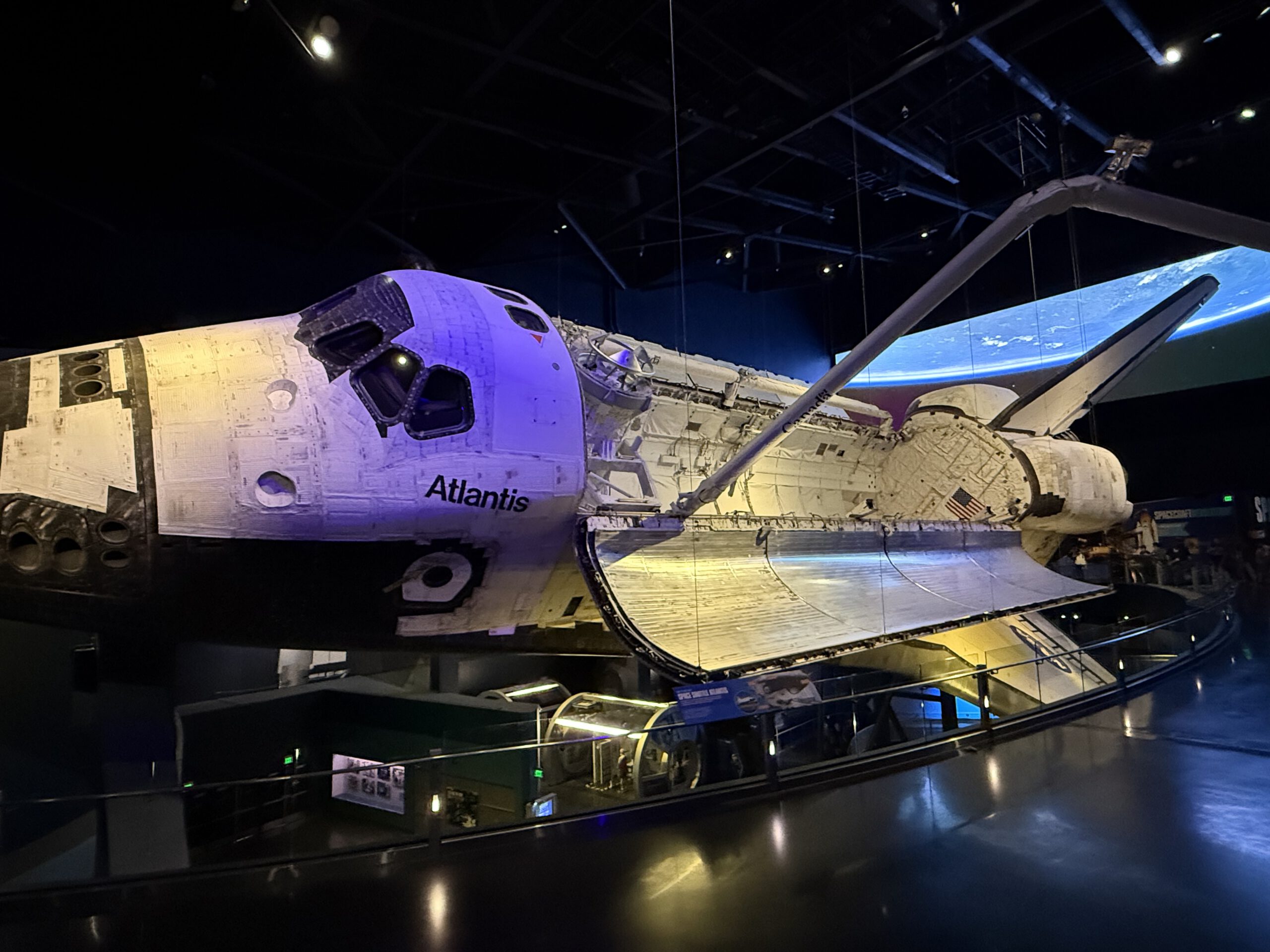
The Space Shuttle exhibit presents Atlantis as if it has just returned from orbit — payload bay doors open, robotic arm extended. Unlike the towering vertical rockets, the Shuttle feels like a spacecraft you could almost board. It represents a different era: reusable orbiters, satellite deployment, International Space Station construction. It was not as powerful as Saturn V, but it was operationally versatile. For thirty years, it defined American human spaceflight.
After our long day at Kennedy Space Center, we returned to Manatee Hammock and waited for dark. Just before launch time, we joined roughly a hundred others along the shoreline.
When the Falcon 9 ignited, the sky turned white-orange. It was far brighter than I expected. The rocket climbed silently at first — almost peacefully — until, many seconds later, the sound reached us across the water. The delay made the experience surreal. Then came the deep, rolling rumble — not sharp, but sustained — vibrating through the ground and your chest. The brightness, the lag in sound, the physicality of the noise — it was far more dramatic than any video conveys. It is one thing to watch a launch on a screen. It is another to feel it.
On the morning of the 20th, we packed up, hitched up, and headed south toward Everglades National Park. By afternoon we were settled into Site B4 at Long Pine Key Campground. From rockets and lunar modules to sawgrass and alligators in less than a day. Florida makes those contrasts possible. And just like that, the space chapter closed and the Everglades chapter began.
| Nights | Total Nights | Miles | Total Miles |
|---|---|---|---|
| 2 | 354 | 414 | 31310 |